

Major Equipment


Carbon Powder Molding Process
I. What raw materials are suitable for carbon powder molding?
The raw material sources for carbon powder molding are extremely diverse. Virtually any powdered material containing carbon can serve as feedstock.
Biomass Carbon Powder (Core Raw Material):
Primary Carbonized Materials: Carbon powder obtained from agricultural and forestry waste such as rice husks, sawdust, bamboo shavings, straw, peanut shells, coconut shells, and sugarcane bagasse after carbonization in continuous carbonization furnaces.
Recycled Waste Materials: Carbon powder obtained by grinding substandard charcoal fragments, waste charcoal, and end/tail pieces from charcoal production. Also includes factory-discarded activated carbon powder, graphite powder, etc.
Mineral Carbon/Coal-Based Materials (Extended Materials):
Coal Powder: Powder produced by grinding various anthracites and bituminous coals.
Coke Dust/Lignite Powder: Powdered coke or lignite generated in metallurgical and chemical industries.
Blended Raw Materials:
Small quantities of coal powder or coke dust can be mixed with large volumes of biomass charcoal powder. Alternatively, fibrous materials like tobacco stems or wood shavings can be added to produce “synthetic charcoal” with enhanced combustion properties.
II. Complete Process Flow (Three Core Stages)
Compared to traditional mechanized charcoal production, the charcoal powder molding process features a shorter workflow and simpler operation. It primarily consists of three stages: raw material pretreatment, mixing, and high-pressure molding.
Stage One: Raw Material Pretreatment
Purpose: Ensure raw material particle size meets molding requirements and establish a foundation for uniform mixing.
Process:
Grinding/Screening: If raw materials contain lumps (e.g., broken charcoal, large coke particles), they must first pass through a crusher. Typically, raw material particle size should be below 5mm to ensure a smooth surface and uniform density in the molded product. This step can be omitted for inherently fine powders (e.g., charcoal powder, coal powder).
Stage 2: Roller Mill Mixing (Critical Process)
Purpose: Thoroughly blend carbon powder with binder and water to achieve a uniformly mixed material with good plasticity.
Principle: Carbon powder is granular and lacks inherent binding properties. A binder must form “bridges” between particles, which develop strength upon drying and curing.
Process:
Feed pretreated carbon powder into the roller mill mixer.
Add binder and water according to the formula ratio. Binder selection and dosage are critical process parameters.
Binder Ratio Reference: Optimal binder addition varies by carbon powder type. For example:
– Charcoal powder: 6% recommended
– Bamboo charcoal powder: 5% recommended
– Rice husk charcoal powder: 4% sufficient due to high ash content and loose structure
Thoroughly mix until reaching a moist consistency where the mixture “holds together when squeezed but crumbles when rubbed.”
Stage Three: High-Pressure Molding (Core Process)
Purpose: Under immense mechanical pressure, compress the mixed material into the desired shape of charcoal products.
Process: Depending on the required product shape and pressure specifications, different types of molding machines are used in this stage.
1. Charcoal Powder Molding Machine (Screw Extrusion Type):
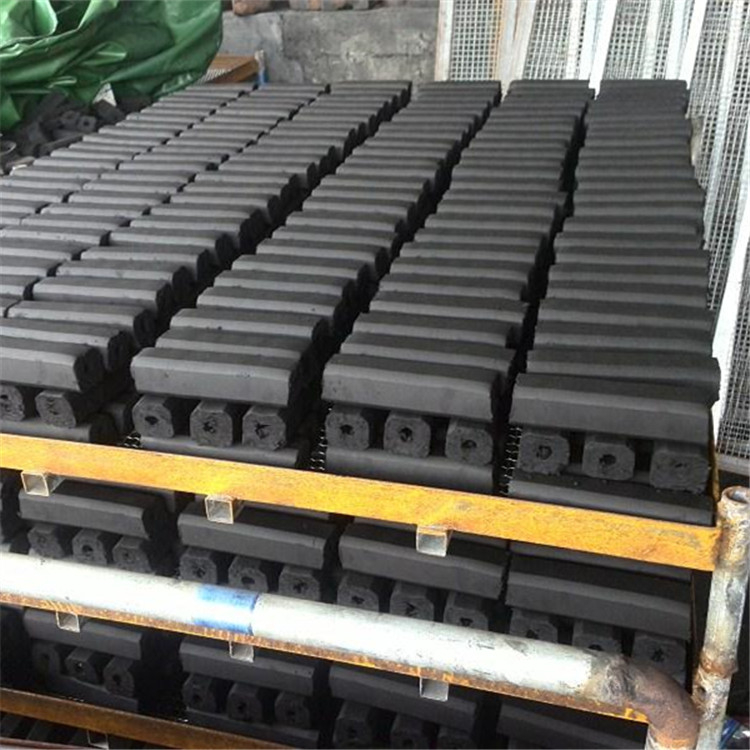
Suitable Shapes: Primarily hollow/solid rods (e.g., hexagonal, square, circular).
Process: Material enters the machine and is forcefully advanced by a screw auger. While not relying on high temperatures to plasticize lignin like traditional briquette machines, the extrusion process generates heat that aids material softening and enables continuous rod extrusion through the die.
2. Hydraulic Charcoal Powder Molding Machine (Hydraulic Press Type):
Suitable Shapes: Diverse shapes including hexagonal hollow, cylindrical solid/hollow, square blocks, plum blossom shapes, etc.
Process: Material enters the mold cavity. A hydraulic cylinder drives the punch to form the material under extremely high pressure (dual top-bottom compression). This intermittent forming method produces one product per cycle. Characterized by high pressure, extremely dense products with smooth surfaces, and excellent impact and transport resistance.
3. Charcoal Powder Pellet Press (Twin-Roll Extrusion Type):
Applicable Shapes: Primarily various spherical forms (round, oval, egg-shaped, pillow-shaped) and block shapes (bar-shaped, loaf-shaped).
Process: Material enters between two counter-rotating rollers with hemispherical grooves on their surfaces via a feeding device. As the rollers rotate, the material is progressively drawn in and compressed. It is formed into pellets at the point where the two grooves converge and then ejected.
4. Multifunctional Press Forming Machine (Punching Type):
Applicable Shapes: Primarily honeycomb coal-like, porous brick-like, and various irregular blocks.
Process: Similar to traditional honeycomb coal machines, material inside the mold cylinder is pressed into shape by a punch and discharged via a conveyor belt.
III. Shapes That Can Be Formed
A major advantage of charcoal powder forming technology is the extremely diverse range of product shapes achievable by simply replacing molds of different shapes (forming cylinders, roll skins, mold cylinders).
Bar-shaped: The most common form, primarily used for grilling and heating. Includes solid round, hollow square, hollow hexagonal, and plum blossom shapes.
Spherical: Mainly used for grilling, hookah charcoal, and household heating. Includes perfect spheres, ellipses, egg shapes, goose egg shapes, and pillow shapes.
Block-shaped: Primarily used in industrial boilers, fireplaces, or specialized applications (e.g., crafts, smelting). Includes square blocks, disc shapes, fan shapes, loaf shapes, and even porous brick shapes with multiple holes like honeycomb coal.
Sheet-shaped: Primarily used for hookah charcoal, incense charcoal, moxibustion charcoal, etc.
IV. Summary of Process Characteristics
Short Process Flow, High Efficiency: Simplifies the traditional five-step charcoal production process (crushing, drying, briquetting, carbonization) into two main steps—crushing and mixing—significantly shortening the production cycle while reducing investment and labor costs.
High raw material adaptability, turning waste into treasure: Not only can it process virgin charcoal powder, but it also effectively recycles waste charcoal, broken charcoal from charcoal production, and various industrial carbon-containing dust, achieving 100% resource utilization.
Significantly reduced energy consumption: Eliminates the high-energy heating stage of traditional briquetting. Simultaneously, residual heat from continuous carbonization can be utilized for drying or heating, substantially lowering overall electricity consumption and reducing costs by approximately 70%.
Controllable and Diverse Product Quality: Formulas and molds can be flexibly adjusted based on different applications (e.g., barbecuing, heating, industrial use) and market demands. This enables production of products with varying shapes, densities, and combustion characteristics, enhancing product value.
High Equipment Adaptability: Multiple machine types—including screw extrusion, hydraulic, twin-roll extrusion, and stamping—accommodate diverse product shapes and production capacity requirements. This enables multi-purpose utilization; for instance, charcoal powder molding machines can be slightly modified for coal powder molding.
Through these steps, discarded charcoal powder or fragments are transformed into diverse, clean, and efficient market products: barbecue charcoal, heating charcoal, or industrial charcoal.
Auxiliary equipment


Enquiry
If you wish to submit a formal inquiry, please complete the following form.