
Carbonization Equipment
Charcoal carbonization furnace
A charcoal carbonization furnace is an environmentally friendly device that converts biomass raw materials (such as wood, straw, etc.) into clean fuel charcoal through high-temperature pyrolysis under anaerobic conditions.

Major Equipment

Horizontal carbonization furnace

Vertical carbonization furnace

Wood chip carbonization furnace
Carbonization Furnace Production Process
The production process of a carbonization furnace is the core process for converting biomass feedstock into charcoal. It primarily consists of three stages: feedstock preparation, high-temperature carbonization, and cooling and discharge. First, raw materials (such as wood chips, logs, coconut shells, and high-density pressed charcoal briquettes) are stacked or fed into the carbonization furnace via a conveyor. Subsequently, within the sealed, oxygen-deprived carbonization furnace, external heating causes the material to pass through four temperature zones—drying, pre-carbonization, carbonization, and calcination—sequentially releasing moisture, wood vinegar, wood tar, and combustible gases, ultimately transforming into black charcoal.
The carbonization furnace is the core equipment of a charcoal production line, serving to pyrolyze biomass feedstock into high-quality charcoal under oxygen-deprived conditions. The following section provides a detailed explanation of the production process for charcoal carbonization furnaces, covering both feedstock types and the complete process flow.
I. Types of Raw Materials That Can Be Processed
The carbonization furnace has a very wide range of raw material adaptability; almost all cellulose-containing agricultural and forestry waste can be used as raw materials. Based on the form of the raw materials, they can be classified into the following categories:
Raw Material Types
Forestry Waste: Branches, sawdust, wood shavings, bark, bamboo shavings, dead leaves, wood scraps.
Agricultural Straw: Corn stalks, sorghum stalks, cotton stalks, bean stalks, sweet potato vines, rice straw.
Fruit Shells and Pomace: Peanut shells, rice husks, sunflower seed shells, coconut shells, coffee grounds, palm shells.
Processing Waste: Distillers’ grains, corn cobs, mushroom substrate, sugarcane bagasse.
Molded materials: Charcoal briquettes (firewood briquettes), sawdust blocks, wood logs, bamboo logs.
II. Complete Production Process Flow of Carbonization Furnaces
Carbonization processes vary depending on the furnace type, but the core principles remain consistent. The following sections describe the process flows for the most typical continuous carbonization furnace and batch (suspension) carbonization furnace, respectively.
(1) Continuous Carbonization Furnace Process Flow
The continuous carbonization furnace is currently the most widely used carbonization equipment, achieving full automation from feeding to charcoal discharge.
Stage 1: Raw Material Preparation and Feeding
Raw material pretreatment: Some raw materials must be crushed to an appropriate particle size (e.g., 5–50 mm).
Drying: The moisture content of the raw material must be controlled below 15% to ensure effective carbonization.
Continuous feeding: Raw materials are continuously fed into the carbonization furnace via a screw feeder.
Stage 2: Carbonization and Pyrolysis
The carbonization process within the furnace is divided into three temperature zones:
Stage
Drying Zone: <160°C, to remove moisture from the raw material
Pre-carbonization Zone: 160°C–280°C, where pyrolysis begins and a small amount of gas is released
Full Carbonization Zone: 300°C–650°C, where lignin and cellulose are fully decomposed to produce charcoal, tar, and combustible gas
Stage 3: By-product Recovery and Utilization
Flue Gas Collection: Combustible gases such as carbon monoxide, methane, and hydrogen generated during carbonization are collected
Purification and Separation: The flue gas undergoes spraying, cooling, and purification processes to separate wood tar and wood vinegar
Combustible Gas Reuse: The purified combustible gas is transported to the combustion chamber to serve as a heat source for the carbonization furnace, achieving self-sufficiency
This process achieves the co-production of “carbon, gas, and oil,” completely resolving the pollution issues associated with traditional carbonization processes.
Stage 4: Cooling and Char Discharge
Continuous Char Discharge: The carbonized biochar is continuously discharged from the bottom of the furnace
Cooling Treatment: The char is cooled using a cooling discharge machine to prevent quality degradation caused by high-temperature oxidation
Packaging and Storage: The cooled charcoal can be directly bagged and stored
(II) Batch (Hanging) Carbonization Furnace Process Flow
The batch carbonization furnace is suitable for carbonizing lump raw materials or molded firewood logs. The operating steps are as follows:
1. Loading
Place sawdust blocks (optimal length 40–50 cm) or wood/bamboo segments into the inner carbonization chamber, typically arranged in 2–3 layers.
Briquettes produced by a briquette machine may also be neatly arranged inside the chamber.
2. Sealing
Close the inner chamber lid and add a layer of river sand exceeding 3 cm in thickness to the upper groove of the carbonization lining to ensure a tight seal.
Install a thermometer to monitor the furnace temperature.
3. Ignition and Heating
Close all valves.
Heat the furnace bottom with firewood or gas. Burn at high heat for 10 minutes to raise the temperature to approximately 90°C, then switch to low heat for slow burning.
During the carbonization process, ensure the temperature continues to rise: maintain 90°C–150°C for at least 7.5 hours, and 150°C–280°C for at least 2 hours.
4. Circulating Combustion
When the temperature reaches approximately 235°C, open all valves and start the induced draft fan and circulation pump
The combustible gas generated during carbonization is recirculated to the furnace bottom for combustion, achieving self-heating
5. Carbonization Complete
Once the temperature rises from 450°C to 600°C and begins to drop, this indicates that carbonization is nearing completion
Observe changes in flue gas: no smoke → little smoke → more smoke → maximum smoke → little smoke; when the flue gas volume noticeably decreases, carbonization is complete
6. Cooling and Char Removal
Stop the fire, close the valves, and hoist out the inner furnace
Cool in a well-ventilated area to below 50°C before removing the finished charcoal
Auxiliary equipment

flue gas purifier
Used for treating flue gas generated during charcoal carbonization and recovering wood tar.
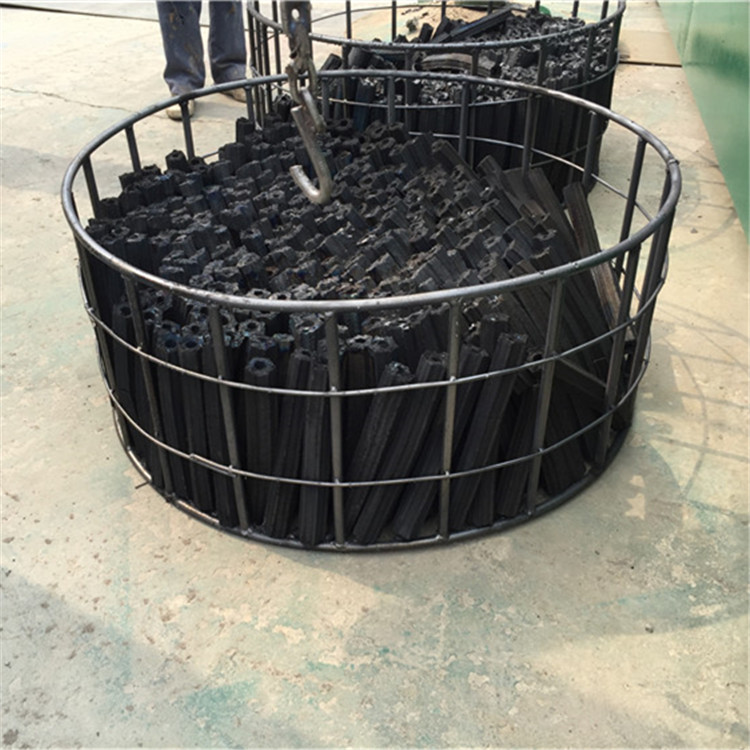
Charcoal hanging basket
The semi-finished charcoal rods are loaded into a frame and hoisted into a vertical carbonization furnace for carbonization.
Enquiry
If you wish to submit a formal inquiry, please complete the following form.
Note: Fields marked with * are required.